info@icubes.org
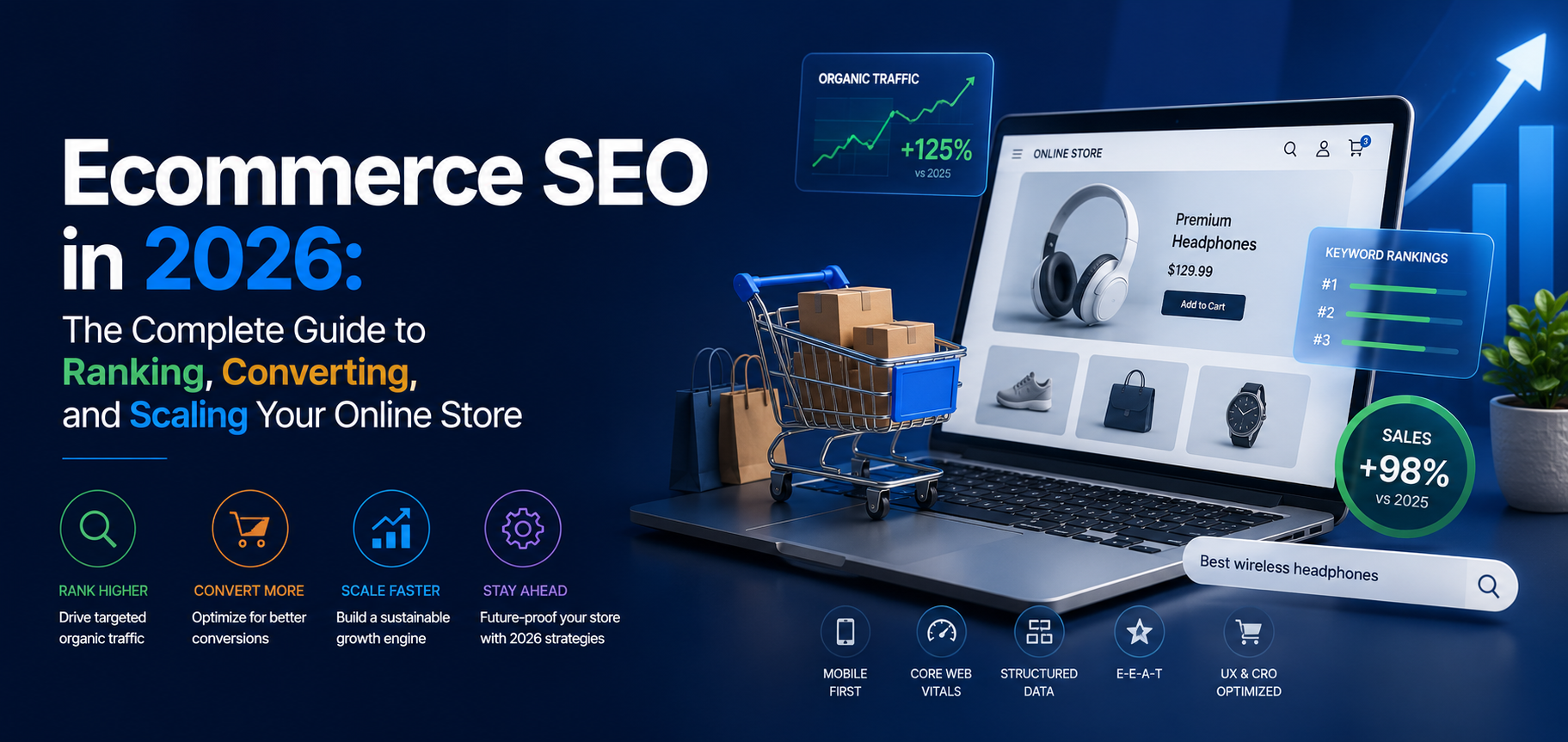
Ecommerce SEO in 2026: The Complete Guide to Ranking, Converting, and Scaling Your Online Store
Running an ecommerce store today feels a lot like opening a shop on a street where thousands of other shops just opened the same week. Beautiful products, a clean website, and even a solid ad budget will only take you so far if nobody can find you when they actually search for what you sell.
That is exactly the gap ecommerce SEO fills.
Over the last decade, we have watched search behavior change more than most store owners realize. Shoppers no longer type “buy shoes online”. They type “best waterproof running shoes for flat feet under 100”. They ask voice assistants for product comparisons. They scroll shopping tabs, image results, AI overviews, and forum threads before ever landing on a product page.
If your store is not showing up across those touchpoints, you are handing traffic and revenue to competitors who are.
This guide walks through everything a serious ecommerce brand needs to know about SEO in 2026, from category page structure and technical fundamentals to the honest questions around hiring an ecommerce SEO agency. We have kept it practical, based on what actually works on live stores we manage every day.
What Ecommerce SEO Actually Means
Ecommerce SEO is the process of optimizing an online store so it ranks higher for the search terms real buyers use, brings in qualified organic traffic, and converts that traffic into sales.
Sounds simple. It is not.
Regular SEO usually deals with a handful of service pages and a blog. Ecommerce SEO deals with hundreds or thousands of product URLs, dynamic filters, out-of-stock pages, variant issues, faceted navigation, duplicate content risks, and a checkout funnel that has to stay fast at all costs.
That is why an ecommerce SEO strategy looks very different from what most local businesses or SaaS companies need. You are not just chasing rankings. You are shaping how search engines crawl your catalog, how buyers move through it, and how every URL contributes to revenue.
Why Most Ecommerce Stores Struggle With SEO
Before we get into the checklist, let us be honest about why so many stores stay stuck.
- Thin or copied product descriptions. Most brands paste manufacturer copy across hundreds of SKUs. Google sees no reason to rank any of them.
- Category pages that read like storage rooms. Just a grid of products with no context, no intent, and no reason for a search engine to consider them the best result.
- Slow, bloated themes. Sliders, video backgrounds, unoptimized images, twenty tracking scripts. Every second of load time you lose costs conversions and rankings.
- No real keyword research. Just a gut feeling about what “customers might type”.
- Zero technical hygiene. Broken redirects, orphan pages, indexable filter URLs, cannibalization across variants, and sitemaps that have not been touched in a year.
Fixing these is exactly what a proper ecommerce SEO audit uncovers before any content or link work begins.
The Ecommerce SEO Checklist Your Store Needs
We use a version of this checklist on every store we work with, whether it is a small Shopify boutique or a large Magento catalog with 40,000 SKUs.
1. Keyword Research Built Around Buyer Intent
Great ecommerce SEO starts with understanding what people are actually trying to buy, not just what they are searching.
For every category and product, we map keywords into three buckets:
- Commercial investigation (best gaming laptop under 1500, top rated stand mixers)
- Transactional (buy KitchenAid mixer red, running shoes free shipping)
- Informational (how to choose a gaming laptop, difference between DSLR and mirrorless)
The transactional ones belong on product and category pages. The informational ones fuel your blog, buying guides, and comparison content. Mix these up and you end up ranking for terms that never convert.
2. Site Architecture That Search Engines Can Understand
Your category structure is the backbone of your SEO. Ideally, any product should be reachable within three clicks from the homepage.
A clean architecture looks like this:
Home > Category > Sub-Category > Product
For a fashion store, that might be Home > Women > Dresses > Summer Dresses > Product. Each level is its own optimizable URL with its own target keyword and its own reason to exist.
If your architecture is a mess right now, restructuring it is one of the highest-impact things you can do. We usually pair this with proper ecommerce web design planning so the redesign and SEO work happen together instead of fighting each other later.
3. Category Page SEO That Actually Ranks
Category pages are the workhorses of ecommerce SEO. They target the highest-volume commercial keywords, and yet most brands leave them as bare grids.
A category page that ranks well usually includes:
- A keyword-focused H1 that matches the buyer’s search
- Intro copy that explains the category and helps buyers choose
- Filters and sorting that do not create endless duplicate URLs
- Internal links to sub-categories and top products
- A short FAQ answering the questions people actually ask
- Below-the-fold long-form content for context and trust
The right balance is important. Nobody wants a 2000-word essay above the products. But 150 words of useful, unique context above the grid, plus a proper section below, is often the difference between ranking on page one and page five.
4. Product Page SEO That Converts
Product pages are where the sale actually happens, so SEO and conversion have to work together.
Every product page needs:
- A unique, descriptive title that matches how people search (brand + model + key attribute)
- A benefits-driven description written for humans, not stuffed with keywords
- Specs, sizing, and usage details in scannable format
- High-quality images with descriptive alt text
- Real customer reviews visible on the page
- Related and complementary products for internal linking
- Product schema markup with price, availability, ratings, and shipping
The mistake most stores make is treating product pages as an afterthought. Done right, they can rank for long-tail buyer keywords that convert at three to five times the rate of top-of-funnel searches.
5. Technical SEO That Keeps Everything Running Smoothly
This is where a lot of ecommerce stores quietly leak traffic without realizing it.
Our technical SEO work on ecommerce sites usually includes:
- Core Web Vitals: LCP, INP, and CLS scores tuned for both mobile and desktop
- Crawl budget management: blocking irrelevant filter combinations, cleaning up parameter URLs
- Canonical tags: pointing variants and duplicates to the right master URL
- Robots.txt and XML sitemaps: keeping only the URLs you actually want indexed
- Redirect audits: fixing 302s that should be 301s, cleaning up chains and loops
- HTTPS and security: mixed content, expired certificates, and other invisible ranking blockers
- Structured data: Product, Offer, Review, BreadcrumbList, and Organization schema
We have seen stores double their organic traffic just from fixing technical debt, before touching a single word of content.
6. On-Page SEO Across the Whole Catalog
At scale, on page SEO for ecommerce is less about tweaking one page and more about creating templates and rules that hold up across thousands of URLs.
Key focus areas:
- Title and meta description templates that pull dynamic product attributes
- Consistent H1 usage tied to the primary keyword for each page type
- Image naming conventions and alt text rules
- Internal linking patterns that push authority to money pages
- URL structures that stay short, descriptive, and hyphenated
The trick is building this into the CMS so every new product added tomorrow follows the same standards without a writer touching it.
7. Content Marketing That Feeds Your Product Pages
An ecommerce store without a content strategy is leaving half its potential traffic on the table. Blog content, buying guides, comparisons, and how-to articles pull in searchers at the research stage and quietly funnel them toward your category and product pages.
A good content marketing engine for ecommerce covers:
- Buyer’s guides for every major category
- Comparison content (X vs Y, best X for Y use case)
- Problem-solving content that ties back to your products
- Trend and seasonal content that captures spikes in search demand
- FAQ content that targets long-tail question keywords
Every piece should link internally to the relevant category and product pages, not float on its own.
8. Link Building That Actually Moves Rankings
Ecommerce sites are notoriously hard to earn links to because product pages are not naturally linkable. Nobody links to a shoe listing for fun.
That is why our link building strategy for ecommerce focuses on:
- Digital PR around brand stories, founder journeys, and data
- Guest posts on relevant industry and niche publications
- Product reviews on trusted blogs and comparison sites
- Broken link building in your niche
- Resource page placements on educational and community sites
- Unlinked mention reclamation
Quality matters far more than quantity here. Ten strong contextual links from real publications will move the needle more than a hundred cheap directory submissions.
9. Local SEO if You Have a Physical Presence
If your ecommerce brand also has retail stores, pop-ups, or a service area, local SEO is a lever worth pulling. Google Business Profile, local landing pages, and store locators help capture the “near me” searches that pure online competitors cannot.
10. Google Shopping and Merchant Feed Health
Organic SEO and paid shopping share a lot of the same signals. Clean product data, accurate attributes, and healthy feeds help both. Our Google Merchant Center work usually runs in parallel with the SEO engagement so nothing pulls in different directions.
Best Ecommerce Platforms for SEO in 2026
We get this question every week, so here is the honest version.
WooCommerce is our default recommendation for most small and mid-sized stores. It sits on WordPress, gives you full control over technical SEO, works with every serious SEO plugin, and does not lock you into rigid URL structures. A well-built WooCommerce store is one of the most flexible SEO platforms available. Our WordPress SEO team handles these engagements every day.
Shopify is fantastic for speed, ease of use, and getting a store live quickly. It has some known SEO limitations around URL structure and duplicate content, but with the right setup, it ranks extremely well. Our Shopify SEO services team specializes in working around those platform quirks.
Magento is the enterprise choice. If you are running a large catalog, multiple stores, complex pricing, or B2B alongside B2C, Magento gives you the power you need. It also requires much more technical SEO attention. We handle Magento SEO for large catalogs where getting the architecture right matters more than anything else.
BigCommerce, Wix, Squarespace, and others all work, with trade-offs. The platform matters less than how well it is set up. A poorly configured Shopify store will lose to a well-configured WooCommerce store every time.
When You Actually Need an Ecommerce SEO Agency
Not every store needs an agency. A very small catalog with clear positioning can often be handled in-house by a savvy founder using a few good tools.
You start needing a real ecommerce SEO agency when:
- Your catalog crosses a few hundred SKUs and you cannot keep up with optimizations manually
- Your traffic has plateaued or is dropping and you do not know why
- Competitors are outranking you on your own brand searches
- A site migration or replatform is coming up and you cannot afford a traffic drop
- You are entering new markets or launching new categories
- You want organic to become a predictable revenue channel, not a lucky bonus
At that point, the cost of not having an agency is usually far higher than the cost of hiring one.
What to Look For in an Ecommerce SEO Agency
Every agency will tell you they are the best. Here is what actually separates the good ones from the rest.
- Real ecommerce experience. Ask for case studies with actual traffic and revenue numbers, not just ranking screenshots.
- A specialist team. Ecommerce SEO needs content writers, technical SEOs, developers, and analysts working together. A single freelancer wearing every hat is a red flag for anything beyond a small store.
- Transparent reporting. You should see exactly what is being worked on, what changed, and what impact it had. Every month.
- Platform knowledge. If they cannot talk fluently about your CMS and its quirks, they will learn on your dime.
- A focus on revenue, not vanity. Rankings are nice. Rankings that bring buyers are the goal.
- Honest communication. SEO takes time. Anyone promising page one in 30 days is either lying or about to get you penalized.
We built iCubes around these exact principles. Ten years of ecommerce SEO work across health, fashion, home goods, travel tech, and B2B has taught us that the boring fundamentals, done consistently, beat every shortcut.
How iCubes Approaches Ecommerce SEO
Every store is different, but our process usually follows the same phased structure so nothing gets missed.
Phase 1: Discovery and Audit. We start with a full technical, on-page, content, and off-page audit. This is where we find the leaks, the wins, and the priorities.
Phase 2: Strategy and Roadmap. We build a 6 to 12 month roadmap with clear milestones, keyword targets, and traffic projections. You know exactly what is happening in month one, three, and six.
Phase 3: Technical Foundation. Fix the crawl, index, speed, schema, and architecture issues first. Nothing else works until this is clean.
Phase 4: On-Page and Category Optimization. Rebuild category pages, rewrite product templates, and roll out internal linking improvements at scale.
Phase 5: Content Engine. Launch a steady stream of buyer’s guides, comparisons, and long-tail content that feeds traffic to money pages.
Phase 6: Authority Building. Digital PR and link building to earn the domain authority needed to compete on high-value terms.
Phase 7: Iterate and Scale. Monthly reviews, quarterly strategy shifts, and continuous optimization based on real data.
If you want a walkthrough of what this would look like for your specific store, our team also offers dedicated SEO consulting engagements for founders and marketing leaders who want to sanity-check their in-house strategy before committing to a full engagement.
Ecommerce SEO Pricing: What You Should Expect
Pricing varies wildly across the industry, and honestly, some of it deserves the reputation.
For a rough range in 2026:
- Small stores (under 100 SKUs, single market): 1,000 to 3,000 USD per month
- Mid-sized stores (100 to 1,000 SKUs, multiple categories): 2,500 to 6,000 USD per month
- Enterprise stores (large catalogs, multi-region, complex): 6,000 USD and up per month
Anything under 500 USD per month for ecommerce SEO is almost always template work that will not move revenue. Anything above 15,000 USD per month should come with a very clear justification.
For very large catalogs, a proper enterprise SEO engagement makes more sense than a standard package, because the workload and coordination is closer to running an in-house department than a monthly retainer.
Ecommerce SEO and Paid Ads: Better Together
One question we hear often is whether SEO or paid ads deliver better ROI. The honest answer is that they work best together.
SEO builds long-term compounding traffic that costs less over time. PPC delivers fast, controllable traffic today. Running them side by side gives you data (search terms, conversion patterns, product performance) that improves both channels.
We also pair SEO with conversion rate optimization so the traffic you are working so hard to earn actually turns into revenue instead of bouncing off underperforming pages.
Ready to Start the Clock?
The sooner you start, the sooner the timeline runs. If you want us to build a scoped plan for your business, whether that is a full SEO program, broader digital marketing support, an ecommerce growth build, or web development to fix the foundation first, we will come back with honest timelines instead of hype. Get a free proposal here and let us map out what results look like on your calendar.