info@icubes.org
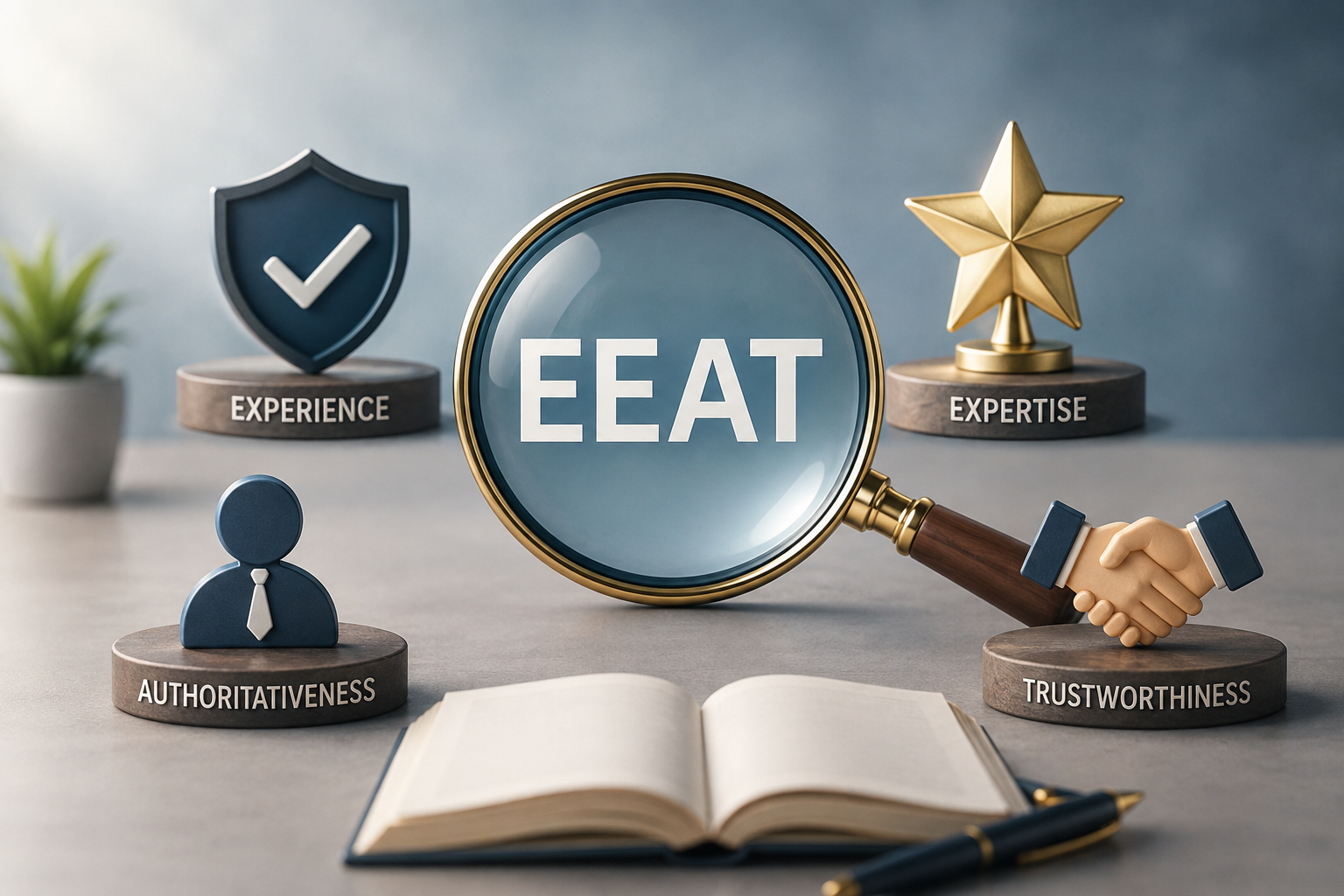
What Is EEAT? Google’s Quality Framework Explained for 2026
What is EEAT? EEAT stands for Experience, Expertise, Authoritativeness, and Trustworthiness, and it’s the framework Google’s Search Quality Raters use to judge whether a webpage genuinely deserves to rank. Introduced as E-A-T in 2014 and expanded to E-E-A-T in December 2022 when Google added Experience to the model, it now shapes how every ranking system evaluates content quality. EEAT isn’t a direct ranking factor, but Google’s algorithms are designed to reward pages that show these four traits and demote pages that fake them. For any site targeting competitive keywords in 2026, EEAT is the difference between visible and invisible.
What Does EEAT Stand For? (Meaning and Page Quality Rating Explained)
What does EEAT stand for? The acronym breaks down into Experience, Expertise, Authoritativeness, and Trustworthiness. What does EEAT mean in practice? Each letter represents a different quality signal Google looks for. Experience is first-hand exposure to the topic. Expertise is depth of knowledge. Authoritativeness is external recognition. Trustworthiness sits at the centre, and Google explicitly calls it the most important of the four. What does EEAT stand for in page quality rating? In the Search Quality Rater Guidelines document, EEAT is the primary lens raters use to grade every page they review. It shapes their overall quality score.
What Is EEAT? A Simple Breakdown of Google’s Quality Framework
What is Google EEAT in plain language? Think of it as Google’s way of asking, “Would a real, qualified person actually trust this page?” What EEAT looks like on a page includes an author with credentials, a publisher with reputation, content that reflects lived experience, and clear signals that the information is accurate and safe. What is EEAT Google using it for? Every content type, but especially YMYL topics (Your Money or Your Life) where wrong information could cause real harm. Medical, financial, legal, and safety-related content gets the strictest EEAT scrutiny.
What Is EEAT in SEO and Digital Marketing?
What is EEAT in SEO? It’s the quality bar you need to clear before Google trusts your content enough to rank it. What does EEAT stand for in SEO practice? Experience, Expertise, Authoritativeness, and Trustworthiness, translated into on-page and off-page signals that search engines can actually measure. What is EEAT in digital marketing? It’s the shift from creating content that ranks through tricks to building content that earns rankings through credibility. Sites that treat EEAT as a checkbox exercise stay stuck on page two. Sites that build it into their editorial process compound gains over time. A strong on-page SEO strategy is where most of this work happens.
What Is EEAT Content?
What is EEAT content? It’s content that visibly demonstrates the four qualities Google looks for, rather than just claiming them. This means author bylines with real credentials, publish and update dates, source citations from authoritative references, first-hand insights (photos, screenshots, case studies, personal observations), and disclosure of who reviewed or edited the piece. EEAT content also includes what’s around the piece: the site’s About page, editorial policy, contact information, and reputation signals across the web. A page can’t have high EEAT if the site it lives on doesn’t.
What Are EEAT Signals? (How Google Measures EEAT Signals)
What are EEAT signals? They are the concrete, machine-readable clues Google uses to score EEAT at the algorithmic level. What is EEAT signals for common examples: author schema markup, mentions of the author or brand on trusted third-party sites, backlinks from reputable domains, HTTPS and site security, transparent business information, review consistency, and content freshness. Google combines these signals with human rater feedback to train its systems on what quality looks like. Your goal isn’t to hit every signal, but to make sure the most important ones (authorship, trust, and citations) are consistently strong across your site.
What Is Authority and EEAT? The Trust Question
What is authority and EEAT connected? Authority is the second-to-last piece of the EEAT model, but it’s tightly tied to the others. Authority is built through recognition: other credible sites linking to you, industry publications citing you, and users returning to your content as a reference. Trust, the final letter, is what authority ultimately produces. A page can have strong expertise but weak authority if no one in the field cites it. And a page can have authority but weak trust if the site has poor security, hidden ownership, or unresolved complaints. All four traits work as a system, not a scoreboard.
What Are EEAT and YMYL in SEO?
What are EEAT and YMYL in SEO? EEAT is the quality framework. YMYL, or Your Money or Your Life, is the topic classification for pages that can affect a user’s health, finances, safety, or major life decisions. Google applies stricter EEAT thresholds to YMYL content. A recipe blog can rank with modest EEAT. A page giving cancer treatment advice cannot. Understanding whether your content is YMYL determines how aggressive your EEAT investment needs to be. Healthcare, finance, legal, and news publishers should treat EEAT as a core operational discipline, not a marketing project.
How Does EEAT Impact SEO and Influence Google Search Results?
How does EEAT impact SEO in measurable ways? Pages with weak EEAT often get filtered out of top positions after core algorithm updates, even when their on-page optimization is strong. How EEAT impacts SEO shows up most clearly during helpful content updates, when Google recalibrates how much weight it gives to unhelpful, low-EEAT content. How does Google EEAT influence search results across query types? For informational queries, high-EEAT pages get preference in featured snippets and AI Overviews. For YMYL queries, low-EEAT pages get suppressed almost entirely. If you’ve lost traffic after an algorithm update, EEAT is usually the diagnosis.
Why EEAT Is Non-Negotiable in 2026
Why EEAT is non-negotiable in 2026 comes down to how search itself has changed. AI Overviews now pull from a smaller set of highly trusted sources rather than the traditional top ten. Zero-click search means visibility depends on being cited, not just ranked. And Google’s helpful content classifier now runs continuously, not just during updates. In this environment, pages without clear EEAT signals rarely make the cut. Sites that treated EEAT as optional in 2022 spent 2024 and 2025 losing ground. In 2026, the gap between EEAT-strong and EEAT-weak sites is bigger than the gap between well-optimized and poorly-optimized ones.
What Is Google’s EEAT Guidelines?
What is Google’s EEAT guidelines document, and where does it live? The guidelines are set out in the Search Quality Rater Guidelines, a PDF Google publishes and updates for its human quality raters. The document is public and free to download. It contains detailed criteria for judging each EEAT trait, with examples of high, medium, and low quality pages. Even though raters don’t directly influence rankings, the guidelines are the clearest picture of what Google is training its algorithms to reward. Every SEO team should read the latest version. Our content marketing team rebuilds client editorial standards around each update.
How to Optimize for EEAT
How to optimize for EEAT in a way that actually shows up in rankings: start with authorship. Add real author bylines, bios, credentials, and links to their profiles on LinkedIn or professional bodies. Second, build the site itself: About page, editorial policy, contact page, HTTPS, and reviews. Third, cite primary sources in your content and get cited yourself. Fourth, update pages when information changes. Fifth, remove or fix low-quality thin pages that drag down site-wide trust. Running a full SEO audit is often the fastest way to see where your EEAT gaps sit.
How to Write EEAT Compliant Articles and Avoid Google Penalties
How to write EEAT compliant articles and avoid Google penalties starts with the author, not the article. Every piece should have a named, verifiable expert attached. Inside the article, back claims with citations, use original examples, and avoid AI-generated boilerplate that adds no first-hand value. Update dates when you make substantive edits, not just cosmetic ones. Never publish content on YMYL topics without expert review. Google’s penalties for weak EEAT are usually algorithmic (silent traffic drops after updates), not manual. That makes them harder to spot and harder to recover from without a structured fix.
Does Profound Help With EEAT Signals?
Does Profound help with EEAT signals? Profound is a newer platform that tracks how brands appear across AI answer engines like ChatGPT, Perplexity, and Google AI Overviews. It doesn’t directly build EEAT, but it helps you measure whether your EEAT signals are reaching the AI systems that matter. If your brand is being cited by AI engines, your EEAT investment is paying off. If it isn’t, Profound helps identify which entity mentions and citations are missing. Other tools in this space include Otterly, Peec AI, and AthenaHQ. Use them for measurement, not for signal creation.
Get a Real Quote Instead of a Guess
EEAT is not a checkbox or a temporary trend. It’s how Google, and increasingly how AI answer engines, decide which sites are worth trusting in an internet drowning in low-effort content. The sites winning in 2026 are the ones building real authorship, transparent policies, and citations that hold up to scrutiny. If you want help auditing your current site for EEAT gaps or building an editorial framework that Google actually rewards, iCubes offers dedicated content and SEO services tailored to E-E-A-T standards.